Exploring creative technology and generative media in textile art
My studio research explores how computational and AI tools can extend handmade textile and mixed-media practice into animation, installation and responsive experiences, creating new ways for audiences to encounter the work while preserving its material character, artistic intent and evidence of the hand.
Building on Time’s Progress and The Crowd, I experiment with AI-assisted animation, computational image-making and digital fabrication, and explore how computer vision, alongside emerging approaches such as world models, vision-language-action models, persistent memory, embodied AI, digital twins and stylistic evaluation, might support more intentional human-AI collaboration.
At the heart of this research are two questions: What happens when handcrafted textile artwork can move or respond digitally while remaining recognizably itself? And how might the processes of making and experiencing the artwork evolve as human and AI systems collaborate?
The experiments shown here are works in progress, not finished digital artworks. Their successes, limitations and failures, and how I evaluate them, are part of the research. I investigate how movement, response and interaction might extend a physical artwork without erasing the qualities that make it itself, and what kinds of creative collaboration could make that possible.
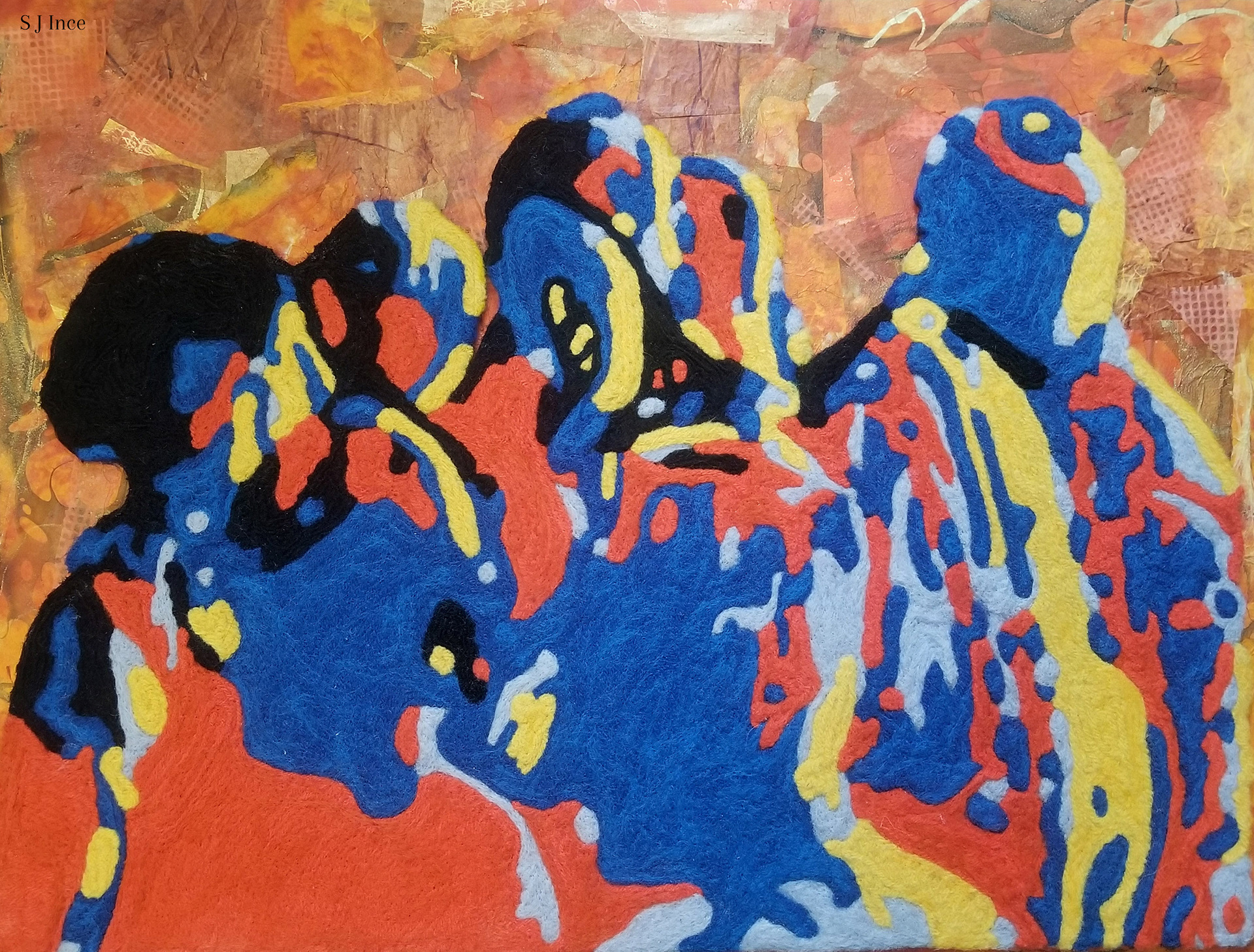
The Crowd (Meetup), 2019
Needle-felted wool, washi and acrylic on board, 61 × 46 × 3 cm.
Needle-felted wool, washi and acrylic on board, 61 × 46 × 3 cm.
The Crowd: Early AI Animation Experiments
The Crowd (Meetup) is a needle-felted mixed-media artwork exploring communication, social connection and individual agency within a group. These early experiments investigate whether generative video systems can add movement to the figures while preserving the original artwork's composition, textile surface, and visual identity.
The results reveal both possibilities and limitations. Movement can create an unexpected sense of life within the still image, but current models may also reinterpret the needle-felted figures, alter details and material qualities, or introduce actions that move away from the original work and the artist’s intent.
Rather than treating these changes simply as technical errors, I use them as part of the research: to understand what an AI system would need to perceive, preserve, remember and evaluate before it could become a more meaningful creative collaborator.
Rather than treating these changes simply as technical errors, I use them as part of the research: to understand what an AI system would need to perceive, preserve, remember and evaluate before it could become a more meaningful creative collaborator.
Early AI animation experiments, 2026
Two 8-second generative video experiments based on The Crowd (Meetup). Although unsuccessful in several respects, the sequences revealed unexpected possibilities and limitations in animating the static textile image. Shown as exploratory research experiments, not as finished artworks.
Two 8-second generative video experiments based on The Crowd (Meetup). Although unsuccessful in several respects, the sequences revealed unexpected possibilities and limitations in animating the static textile image. Shown as exploratory research experiments, not as finished artworks.
Current direction
I am developing an experimental framework and toolset to explore how physical artworks might participate in responsive human-AI encounters.
Current areas of investigation include computer vision and spatial understanding, digital representations of physical artworks, persistent memory, material and stylistic fidelity, and evaluating generated behaviour and interaction.
A current project focuses on Time’s Progress, my 2019 needle-felted and electroluminescent artwork. I am investigating how its abstracted wool faces might eventually speak, move, and respond while remaining recognizably themselves as textile objects, rather than being reinterpreted by generative systems as conventional human faces.
The work is ongoing. My objective is not to replace the physical artwork with a digital version, but to explore how computation might extend the ways audiences can encounter and interact with it.